I.
Made to order —
your own exams, tasks, difficulty, and pass criteria — built for your organization.
AIQCAT stands for AI Quantitative Capability Assessment Test. It does not test the AI, and it is not an IQ-style intelligence test — it measures a person's AI IQ: how skillfully you put generative AI to work to solve real tasks.
I took the exam twice, and both times it laid bare the limits of my skills, my AI-agent control, and my Claude Code setup. But I genuinely enjoyed it. Rather than testing knowledge or basic literacy, it asks how well you can steer AI to reach the result you want — very practical.
Reading the meticulous feedback convinced me: your dialogue log with AI is an X-ray of the trial-and-error in your thinking that never shows up on an answer sheet. We're moving from grading by score to questioning the quality of the process. Testing is changing from the ground up.
Took the exam. Once it started, I researched its goals, built an AGENTS.md and my own scoring rubric, and started building a harness. I ran low on time, but thanks to the harness I got through every question. So much fun it was a rush — and I grew.
This is way too much fun. Total rush.
I scored 81 and honestly it stunned me. But even more, it tests your ability to abstract a concept and apply it elsewhere, which really made me think. A genuinely educational qualification.
My results came in! It's a higher score than I ever got on college entrance exams. The report gives detailed feedback on my strengths, and the exam itself was so mentally exhausting yet fun. I'll take it again.
Got my results back! My score was higher than expected. The analysis even pointed out my weaknesses and gave me new perspectives. There are higher ranks above this, and I hope to reach them someday.
Finished round 2. What's great is it teaches you how to think about what to ask AI and how. "Build a promotion," "analyze this data" feels vague at first, but once you know how to ask, it takes shape.
It tests not just how well you wield AI, but also the defensive side of real-world implementation. Neither blindly trusting AI nor flatly rejecting it scores well. It's designed to make you think.
My results arrived! I ran out of time and skipped questions, so I expected to fail, but I scored decently. And the feedback is spot-on: since I haven't built agents, I rely on single-AI exchanges and swarm control is my weak point. Exactly right.
After the brutal first exam in March left me reeling, I braced myself — but this one is designed so you realize your own foundational dev skills as you go. "Oh, I can actually do this now!" A great exam.
The red-pen feedback and radar chart were amazing — it felt like scoring by criteria. Made me wonder if schools will go hybrid, and what it'd be like if I were a kid taking this.
Last time, what ate up my time wasn't the problems — it was the file format, naming conventions, and pasting in chat logs. That's exactly like real work, where you fuss over delivery formats. A truly practical exam.
I've deliberately gone through life without collecting certifications — but this is the one exam I chose to take.
My results came back — certified rank S2?! For real?! This grandpa just tried not to land out of the rankings, and got way more than I expected. Age really has nothing to do with it.
My score was worse than I expected, so I asked the support chat on a whim — and they taught me a ton. Super helpful. I figured they'd patch it out, but instead they made it an official feature!
It's about time consultants start pitching 'do an AI-skills assessment, then tie it to performance reviews' — and it already exists. The name caught my eye, but when I looked at the questions, they were the real deal.
My results came in — I made the top 5%! It gave me the confidence that I can become a solid AI operator.
I have a feeling the swarm-AI evaluation system used here is going to become the standard going forward.
I've taken it since the very first round, so I'm thrilled.
I got the S1 rank, top 5% — an exam that measures your ability to solve real-world tasks with generative AI. Next I'm aiming for the top 1% T rank.
I landed solidly in the top tier. It's at least some proof I can use AI well, and I'll keep pushing to bring this skill to Tohoku and small businesses.
I got S2. Aiming higher and higher.
I did zero prep, ran out of time, and forgot to report a failed file upload, so I figured I'd blown it. For that, this result isn't bad at all.
Beforehand I built Claude Code skills from the public info, and ran things in parallel during the exam. Switching to lighter models for some tasks and researching which model to use for images and video felt essential.
My results are finally in. My implementation and practical scores were high, so I'm satisfied. The scope is so broad that scoring high across everything is genuinely tough.
Even the parts I scrambled through under time pressure scored well. I've come to realize how important it is to think through those little gaps.
My results came back, nothing but room to grow! It really hit home how deep the world of generative AI is. I'd love to hear how the top rankers prepared and tackled it.
I checked my results for the first round: certified rank S1, overall score 70.
It felt closer to timed project-based learning. It would be fun to do in a school setting. With about an hour per question, you could read the AI's answers and really get to the concepts.
It pushed me to subscribe to Claude's paid plan and really start using Claude Code. I'd seen the buzz online, but actually trying it, I was surprised how powerful it is. This isn't just a tool for programmers.
The questions are a treasure trove of usable keywords — what they are and how to apply them. Feed that info and your goal to an AI and you're ready to go. The way the questions organize information is genuinely valuable.
Exam day. There were no sample questions, so I went in cold. If I can gauge where I stand and figure out what to do next, that's a win — my first attempt rated me solid overall but weak on development.
I took it. It has you build while learning with AI — really interesting if you take your time with it.
This feature is great.
I checked my results for the first round. Certified rank S1, overall score 77.
I saw the top score, and it belonged to someone who's a heavy user. I lost (my score was 70), but somehow I'm glad it turned out that way.
My results. I need to work a bit harder. I already knew my concept-transfer skills were weak. Next time I'll take it on a device I'm used to.
My results are pretty decent, I'd say.
My results aren't bad at all.
My result was A1. As someone working at an AI company, I wanted at least S1. I only used Tenbin AI Biz and ChatGPT, no autonomous AI agents.
Here's where I'm at right now. I did better than I expected. I'll cover my weak spots while building on my strengths.
So satisfied!
I feel like this could just clear a major company's internal approval process, so it's a safe bet.
The sample questions look insanely hard?!
your own exams, tasks, difficulty, and pass criteria — built for your organization.
a proprietary construct graded on real work by a swarm of AI evaluators.
every team and every level on one AI-competency data platform.
AIQCAT is not a one-size-fits-all certificate. The thing it measures — AI competency — is proprietary and rigorous. How it is measured is yours to define: your exams, your tasks, your difficulty, your pass criteria. The result is a single, comparable picture of AI competency across your whole organization.
How it works →Define the test scope, item formats, and difficulty for each role or department. Your bar, not a generic one.
A factory of agents builds your exam in parallel, then refines it with you through dialogue.
Submissions are graded on real artifacts by a swarm of AI evaluators — consensus scoring, reduced single-model bias.
Authoring, grading, analytics, and delivery connect into one AI-competency data platform — every team, one view.
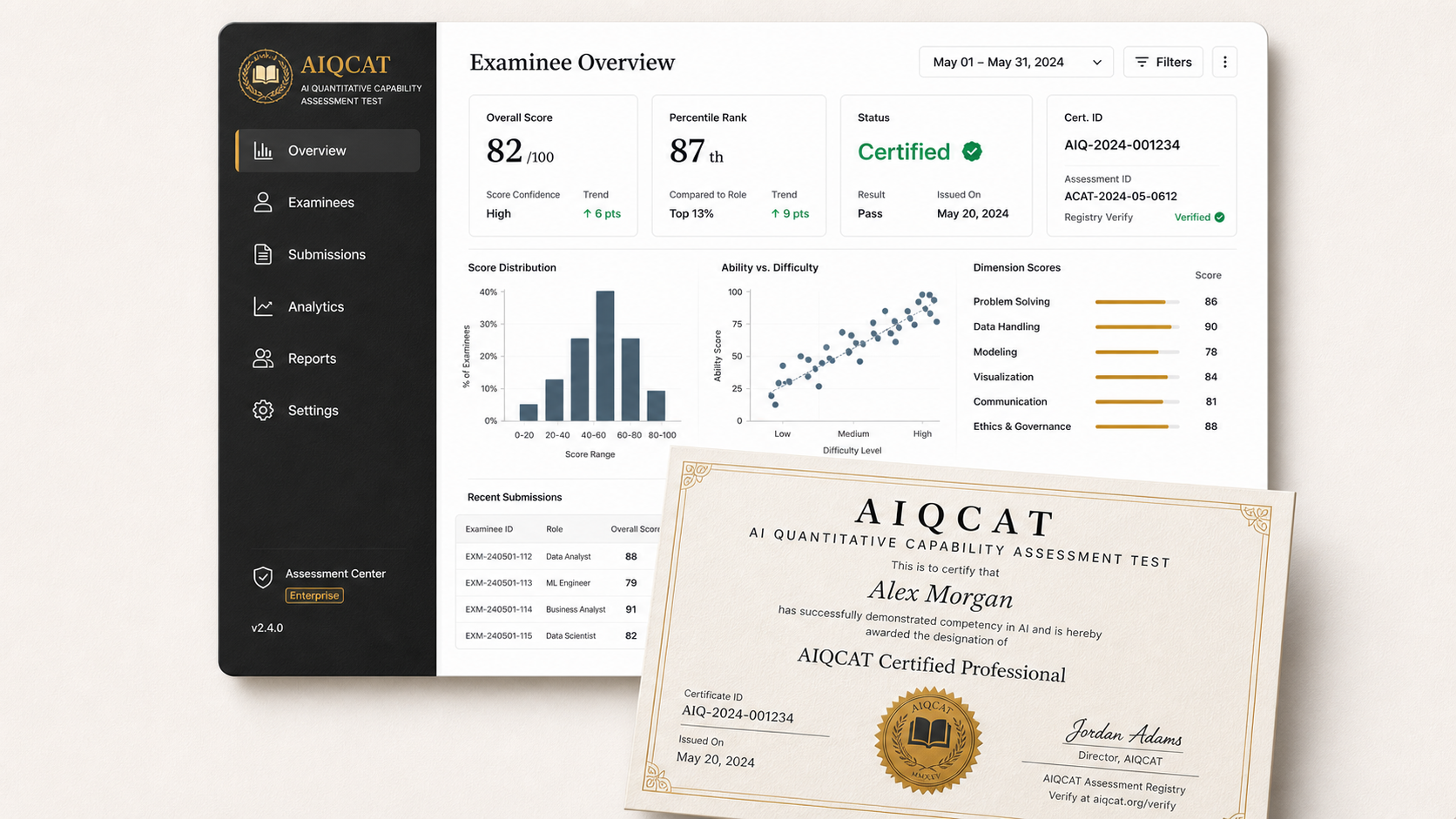
A comprehensive view of each candidate's performance across all dimensions. Understand ability level, distribution, deviation, and answer spread on a single integrated dashboard.
| Excel | Image | Video | Overall | Status | ||
|---|---|---|---|---|---|---|
| Q2: Sales Analysis | 92/100 | Graded | ||||
| Q2: Forecast Model | 88/100 | Graded | ||||
| Q2: Market Insight | 75/100 | Graded | ||||
| Q4: Executive Deck | 93/100 | Graded | ||||
| Q5: Case Summary | 81/100 | Graded |
Track every deliverable across Excel, PDF, images, and video in a unified matrix. Real-time grading status and scores provide transparency and operational efficiency at scale.
Our AI Assistant evaluates each submission in depth, providing a radar view across dimensions and red-pen style improvement comments directly embedded in the candidate's work.
Improve data cleaning steps and handle missing values more systematically.
Model assumptions are not fully justified. Provide clearer rationale.
Charts could be more effective with better labels and annotations.
Executive summary should highlight key insights and recommendations.
The exam runs on a rolling national schedule, with new sittings opening as earlier ones close. Reserve a seat for an upcoming date below — this list updates on its own as the calendar moves forward.
Entry fee (tax included): ¥7,000 early bird, ¥9,800 standard, ¥13,000 last-minute.
Notice: Temporary suspension of registrations and purchases
We are currently integrating this service with another business. As a result, exam dates from November 2026 onward have not yet been confirmed, and new registrations, subscriptions and additional purchases are temporarily suspended. We will announce when registrations resume as soon as the schedule is finalised. We sincerely apologise for any inconvenience and appreciate your understanding.
Times are shown in each region's local time, converted from the Japan Standard Time (JST) sitting. Registration and payment are handled on the exam portal.